
 Back
BackAgropalma’s social and environmental initiative is an example of sustainable development in the Amazon
With SOMAR program, the company is investing in dialogue and community leadership to promote income, education, and environmental preservation in Pará
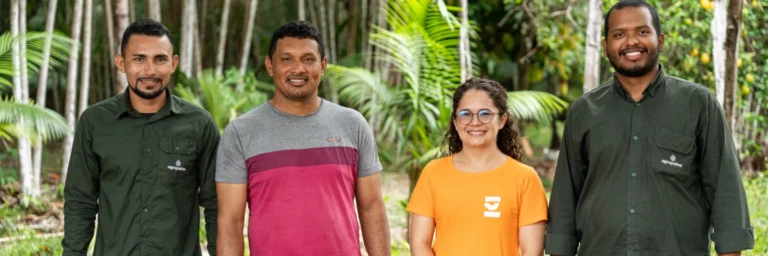


Pedro Silva Costa (family farming supervisor at Agropalma), José Maria Pompeu Leão (farmer and community leader), Raquel Costa (project analyst at Earthworm Foundation Brazil), and Marcus Vinicius Braga (sustainability analyst at Agropalma)
For over 40 years, Agropalma, a Brazilian company that is a global benchmark in sustainable palm oil production, has maintained an extensive farm in Tailândia (PA), about 200 kilometers from Belém – one of the most deprived regions of the Amazon in Pará.
Surrounding the property are dozens of villages, including settlements, rural clusters, and traditional communities. They all share a history of vulnerability: limited access to income, basic infrastructure, and education opportunities.
According to IBGE, almost half of the residents there live on up to half the minimum wage, only 5% of households have sewage systems, and the school enrollment rate is among the lowest in the country.
These populations are the focus of SOMAR program, a social and environmental responsibility initiative promoted by Agropalma, which has been transforming the reality of the region by fostering human development, income generation, and community empowerment.
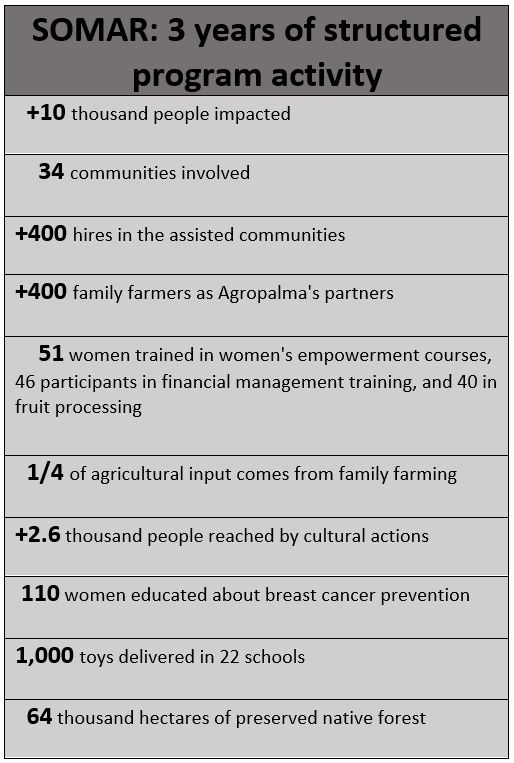
About to celebrate its third anniversary, the program has already had a positive impact on more than 10,000 people. It consolidates practices developed by the company over more than two decades, now with a structured methodology and technical support from the global organization Earthworm Foundation.
Building solutions with those who live in the territory
“The program arose from an internal movement to enhance our relationship with nearby communities,” says Túlio Dias Brito, Agropalma’s sustainability officer. “We identified local leaders, opened a dialogue with the population, and began to build solutions together for common challenges.”
Since then, SOMAR has acted as a permanent channel for listening and partnership with more than 30 communities neighboring the company’s operations, belonging to the cities of Tailândia, Moju, Acará, and Tomé-Açú. 34 villages are included this year, and in 2026, another four will be integrated.
“SOMAR is not a welfare program,” emphasizes Mônica Bernardo Neves, the company’s sustainability manager. “It is a long-term partnership. The company provides support and guidance, but the communities play an active role in their own development,” she adds.
Four pillars of action have been identified—education, infrastructure, environment, and health and well-being—and priorities within each pillar are defined based on participatory mapping exercises conducted with each community. “Once the demands and priorities have been mapped, we develop actions throughout the year and, at the end, we meet again to assess the results,” explains Neves.
“SOMAR is not a welfare program. It is a long-term partnership. The communities play an active role in their own development,” says Mônica Bernardo Neves, the company’s sustainability manager.
Education and culture: the beginning of a new cycle
On the educational front, SOMAR offers technical, vocational, and personal development courses, which have already benefited hundreds of residents. Since 2023, training courses have been offered in financial management, fruit processing, and women’s empowerment, as well as courses in partnership with Senai in areas such as mechanics and electrical engineering.
In one of the groups formed, 51 women completed courses focused on financial independence – and many are already applying what they learned to small local businesses. “These actions prove that it is possible to create a virtuous cycle of development,” Brito points out.
SOMAR also offers lectures on health, physical activity, good production and cultivation practices, among other topics, as well as cultural initiatives that combine learning and leisure. This is the case with (Re)ciclo de Cinema Project, involving 600 children and young people, and Cine Agropalma, which brought together more than 2,000 people, many of whom were experiencing cinema for the first time.
Another highlight is the support for family farming with palm oil, which connects small producers to Agropalma’s supply chain, a pioneering effort by the company that began 23 years ago and today benefits more than 300 partner farmers. Currently, a quarter of the company’s agricultural raw materials come from family farmers, who receive technical assistance and have guaranteed purchases.
At the same time, over these three years, the company has also strengthened the local economy by hiring directly from the communities covered by the initiative. More than 400 people have been hired, one of the most significant results of the program to date, according to Neves.
Infrastructure and citizenship: small achievements that change daily life
SOMAR’s actions also take the form of tangible improvements in infrastructure and quality of life. Working with local authorities, road maintenance, for example, has benefited around 1,000 people, while a recent donation of water tanks has helped more than 1,300 residents in areas without piped water.
Another example, even before SOMAR, but one that clearly illustrates the spirit of the program, is access to banking services: dialogue promoted by the company with a major bank enabled the installation of an ATM in one of the villages, reducing long trips to the city and promoting financial inclusion.
“The nearest ATM was 70 kilometers away, in the city. People used to go to the bank only once a month, all on payday weekend, and faced long lines, in addition to having to withdraw their entire salary at once,” says Brito. “With the ATM, the village gained connectivity, and people started using debit cards and organizing their money better. That’s also development,” he adds.
“Investing in sustainability also means investing in the longevity of the business.” Túlio Dias Brito, Director of Sustainability at Agropalma
Environment: sustainability as a value
Environmental commitment is a pillar of Agropalma and underpins both its social actions and production processes. At SOMAR, one of the fronts is investing in environmental education, with experts giving lectures in community schools on recycling, forest conservation, water, energy, and the importance of biodiversity.
In the business, which is historically controversial due to the association of palm oil with harmful environmental practices in other countries, the company seeks to show that it is possible to do things differently. To this end, it has adopted the NDPE (No Deforestation, No Peat, No Exploitation) concept.
Since 2001, the company has not only banned deforestation, but also maintains an extensive biodiversity conservation and monitoring program, with 64,000 hectares of native forest. In addition, it ensures that no planting takes place on peat soils and that labor laws are strictly enforced, with external audits and partnerships to ensure formal and safe working conditions.
“Investing in sustainability also means investing in the longevity of the business,” emphasizes the executive. “Our sustainable reputation allows us to operate in more demanding markets and adds value to the company. It is often difficult to measure, but the value generated is enormous,” he says.
No to deforestation: of Agropalma’s 107,000 hectares of land in Pará, 64,000 are forest reserves, corresponding to 60% of its total area (Agropalma/Press Release).
With the 30th UN Climate Conference scheduled to take place in Belém, Agropalma will have the opportunity to show the world its example with SOMAR, showing how palm oil production can be a driver of human, economic, and environmental development, a triad that directly addresses the pillars of COP30.
“Belém has been our home since 1997,” says Túlio Dias Brito. “We are proud to host such an important event. We want to show that we are part of the solution, not part of the climate problem,” he says.
Source: Exame Online (10/27/25)